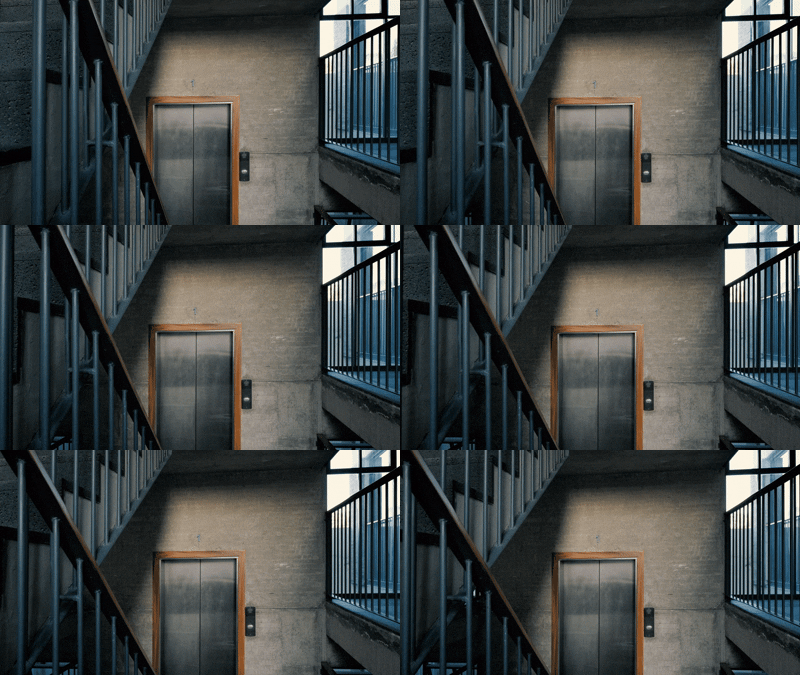
Reckon Elevators' Hydraulic Lifts provide an exceptionally smooth and quiet ride. They are ideal for low-rise commercial buildings, residential villas, and industrial applications where headroom or pit depth is restricted.
Operating on a fluid-driven mechanism, these lifts do not require a large overhead machine room, offering architectural flexibility and reduced construction costs. They are renowned for their durability and heavy-lifting capabilities.
Saves valuable building space. The power unit can be placed up to 10 meters away from the shaft.
Hydraulic action ensures jerk-free starts and stops, offering a premium floating sensation.
Lower installation and maintenance costs compared to traction lifts for low-rise buildings.
In power failure, the lift can be easily lowered to the nearest floor using a manual valve.
Versatile solutions for various environments.
Perfect for existing homes due to minimal civil work and pit requirements.
Ideal for moving products or customers between 2-3 floors comfortably.
Heavy-duty hydraulic cylinders can lift tons of weight with ease.
Reliable solution for automobile elevators in multi-level parking.

| Capacity | 320 kg - 5000 kg |
| Speed | 0.3 m/s to 0.6 m/s |
| Max Travel | Up to 20 meters (approx 6 stops) |
| Pit Depth | 1200mm (Standard) / 300mm (Low Pit) |
| Machine Room | Not Required (Small Cabinet Only) |
| Drive | Hydraulic Pump & Cylinder |
Transparent info to help you make the right choice.
Hydraulic lifts are generally slower (max 0.6 m/s) compared to traction lifts, making them less suitable for high-traffic or high-rise buildings.
They often require a higher starting current and can consume more energy per trip than counterweight-balanced traction lifts.
With continuous heavy usage, the hydraulic oil can heat up, which might require additional cooling mechanisms in very hot climates.
Hydraulic lifts are best suited for low-rise buildings, typically up to G+5 floors or a maximum travel height of about 20 meters.
One of the biggest advantages of hydraulic lifts is safety. In case of a power cut, the lift can be easily lowered to the nearest floor by manually opening a valve, allowing passengers to exit safely.
No, a dedicated machine room on the roof is not required. You only need a small space (like a cabinet or under the stairs) for the hydraulic pump and controller.
Get a robust and cost-effective hydraulic solution.